Electronic shelf labels by sector
Electronic Shelf Labels for Butchers and Fish Counters
Keonex is a manufacturer and implementer of electronic shelf labels. How we work and why we say so: methodology and transparency.
On this page (9)
- How counter prices actually move
- The fish ticket in Great Britain
- The meat counter in Great Britain
- Unit pricing: per kilo in the UK, per pound in much of the US
- US country-of-origin labeling at the case
- Scale, till and label: pick one master
- Ice, brine and wash-downs
- When it pays for an independent shop
- What we did not cover
At a butcher’s or fish counter the electronic label mostly shows a price per kilo, or per pound in the US, that moves with the market and the day’s delivery, next to origin and catch details the law requires. It earns its place only if it reads the same price as the scale and survives ice, brine and daily wash-downs.
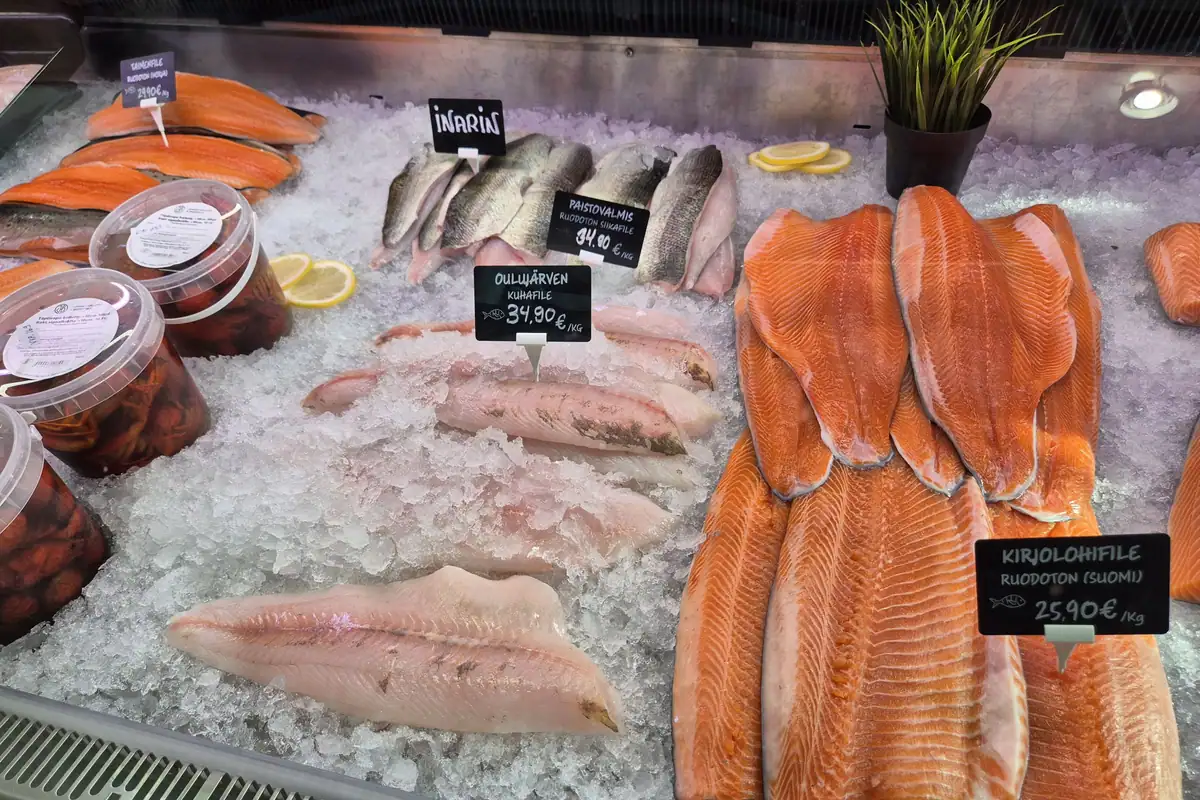

This guide covers the service counter: an independent butcher, a fishmonger on a market, or the fresh counter in a supermarket. The rest of the grocery store is in the supermarkets guide.
How counter prices actually move
Fish prices follow the morning’s landings and the wholesale market. Cod, haddock or prawns do not cost the same on Tuesday and Friday, and shellfish jumps before Christmas. Meat is steadier through the week, but the cuts on show rotate, weekend offers come and go, and barbecue season or Thanksgiving turkeys reshape the counter for weeks.
That rhythm gives the counter three habits a paper ticket handles badly:
- Changes land first thing in the morning, when the delivery arrives and before the doors open.
- Trays change species. Yesterday’s hake tray holds squid today, so the label belongs to a position, not to a product, and has to be reassigned.
- Few items, high stakes. A fish counter shows dozens of species, not thousands of SKUs, but a wrong price per kilo on lobster costs real money on either side of the till.
The fish ticket in Great Britain
Fish carries more mandatory information at the point of sale than almost anything else in a shop. Business Companion, the trading standards guidance service, lists what loose fish must show in England and Wales, under the Fish Labelling Regulations 2013 and the retained EU rules they enforce:
| Particular | What it means on the counter |
|---|---|
| Commercial designation | The legal name from Defra’s list, not a local nickname |
| Scientific name | Required, but it may be given on a separate poster |
| Production method | Caught at sea, caught in fresh water, farmed or cultivated |
| Catch or production area | Where it was caught or farmed |
| Fishing gear category | Trawl, line, net and so on |
| “Defrosted” | If previously frozen fish is sold thawed |
The guide adds an exemption: fish worth under 20 euros (about £18) sold direct to consumers by the person who caught it is exempt from the first three items. And fish, crustaceans and molluscs are all on the list of 14 allergens, which matters as soon as the counter sells fishcakes, marinated fillets or dressed crab.
An electronic label helps here because the particulars change together. When the cod on the counter switches from North Sea trawl to Icelandic line-caught, price, area and gear all change at once. A system that pulls them from the goods-in record changes all four; a hand-written card usually changes only the price.
The meat counter in Great Britain
For beef, GOV.UK’s guidance on the compulsory beef labelling scheme sets the origin particulars: a reference code that traces back to the animal or group of animals, and the countries of birth, rearing, slaughter and cutting. That is four origin fields plus a code, which does not fit legibly on a small shelf label. Counters typically use a larger label, or keep origin on a card and let the electronic label carry the cut, the price per kilo and any offer.
Prepared products such as sausages, burgers and marinated cuts bring allergens with them, under the same non-prepacked food rules that apply to delis and cafés.
Unit pricing: per kilo in the UK, per pound in much of the US
In Great Britain the Price Marking Order 2004 requires a unit price for products sold from bulk. Its small-shop exemption covers pre-packed goods in constant quantities, so it does not let a small butcher drop the price per kilo on meat weighed at the counter. Amendments that took effect in April 2026 require prices to be unambiguous, legible and easily identifiable, and extend unit pricing to promotional and loyalty prices; our till versus shelf price page covers what happens when the label and the till disagree.
In the United States there is no federal unit pricing rule. According to NIST, nine states and one territory make unit pricing mandatory, eight states and two territories have voluntary rules and 33 states have none. In practice, random-weight meat and seafood in the US is sold by the pound, and the scale label carries the price per pound and the total. The shelf or case label is where the price per pound is advertised.
US country-of-origin labeling at the case
US COOL now applies to a narrower list than many shoppers think:
- Fish and shellfish stay covered. Under 7 CFR 60.300, the retailer must declare the country of origin and the method of production (wild or farm-raised), on a placard, sign, label, sticker, band, twist tie, pin tag or other format, placed conspicuously. It may be typed, printed or handwritten.
- Beef and pork are out. A final rule published on 2 March 2016 removed muscle cuts and ground beef and pork from mandatory COOL after Congress changed the law.
- Who counts as a retailer. COOL applies to retailers as defined under the Perishable Agricultural Commodities Act (7 CFR 60.124). Under 7 U.S.C. 499a, a business buying perishable produce for retail sale is only treated as a dealer once its invoice cost for those purchases exceeds $230,000 in a calendar year. Many independent fish markets therefore sit outside the scheme; supermarket seafood counters do not.
For a US seafood case, the useful label shows price per pound, country of origin and “wild” or “farm-raised” side by side, and changes all three together when a new lot arrives.
Scale, till and label: pick one master
The most important technical question is not which label to buy but where the price lives. A counter runs three systems: the point-of-sale or back office, the scale, and the labels. There are three common set-ups:
| Set-up | How it works | Watch out for |
|---|---|---|
| Price set in the back office | Pushed to scale and labels | Scale that misses an update keeps charging the old price |
| Price set on the scale | Label copies the scale | Back office and till fall behind unless they sync |
| Price set at goods-in, per lot | Price and origin arrive with each delivery | Needs disciplined receiving; fits fish best |
We have not found a public UK or US case that publishes figures for electronic labels wired to counter scales; the integrations exist in vendor and scale-maker material, which we do not treat as evidence. Ask for a timed test in your shop: change a price where the master lives, then time how long until the label shows it and the scale prints it.
Ice, brine and wash-downs
The fish counter is the harshest place in retail for a label: crushed ice, salt water, hose-downs at closing time and temperatures a few degrees above freezing. Meat counters are drier but chilled and sanitised daily.
- Sealing. Ask for the IP rating of the label and of the holder.
- Temperature. Standard e-paper labels are usually specified for room temperature. Freezer-rated models exist; one distributor listing gives -25 to 0 °C. The chilled and frozen guide explains what to test.
- Viewing distance. Customers read a counter from a metre or more away; small labels lose.
- Fast reassignment. Staff need to link a label to a new species from a handheld or the scale in seconds.
When it pays for an independent shop
A butcher or fishmonger with thirty or forty counter positions saves few labour hours. The case rests on getting the price and the mandatory particulars right every morning, and on being able to change a price at lunchtime when a second delivery lands. Count your real positions and weekly price changes, put them through the total cost calculator, and read the pricing hub for what a quote should include. If you also sell fruit and vegetables, the greengrocers guide covers origin and class rules.
What we did not cover
Scotland and Northern Ireland have their own fish labelling instruments, and shellfish, game and protected-name products carry extra rules. Legal texts were read on 10 November 2026; this is not legal advice. This site is published by Keonex, as explained on the about page.
Frequently asked questions
What must a fish ticket show at a UK fishmonger?
Under the fish labelling rules summarised by Business Companion: the commercial designation, the scientific name (which may sit on a separate poster), the production method, the catch or production area, the category of fishing gear and, where relevant, the word 'defrosted'. Fish is also one of the 14 allergens. Add the price per kilo for goods sold loose.
Do small butchers in the UK have to show a unit price?
For meat and fish weighed in front of the customer, yes. The small-shop exemption in the Price Marking Order covers pre-packed goods in constant quantities, not products sold from bulk, so loose meat and fish still need a price per unit of quantity.
Does US country-of-origin labeling apply to steak?
Not any more. Muscle cuts and ground beef and pork were removed from mandatory COOL by a final rule published on 2 March 2016. Fish and shellfish, chicken, lamb and goat remain covered, and fish must also show whether it is wild or farm-raised.
Can an electronic label replace the scale ticket?
No. The shelf label shows the price per kilo or per pound and the mandatory particulars; the scale weighs and prints the price for that piece. What matters is that both read the same price from the same system.
Will an e-paper label survive crushed ice?
Some are built for it, many are not. Ask for the IP rating and the operating temperature in writing, check that the holder is as sealed as the screen, and trial one label on ice through a full week of wash-downs before ordering.
Sources
- Business Companion, food labelling for fishmongers (last reviewed July 2025; accessed 2026-11-10)
- The Fish Labelling Regulations 2013 (legislation.gov.uk; accessed 2026-11-10)
- The Price Marking Order 2004, article 5 (legislation.gov.uk; accessed 2026-11-10)
- Gordons LLP, Price Marking (Amendment) Order comes into force (16 April 2026; accessed 2026-11-10)
- GOV.UK, comply with the compulsory beef labelling scheme (accessed 2026-11-10)
- 7 CFR 60.300, country of origin notification for fish and shellfish (Cornell LII; accessed 2026-11-10)
- 7 CFR 60.124, definition of retailer for fish and shellfish COOL (Cornell LII; accessed 2026-11-10)
- 7 U.S.C. 499a, PACA definitions including the $230,000 purchase threshold (Cornell LII; accessed 2026-11-10)
- Federal Register, 2 March 2016, removal of mandatory COOL for beef and pork (GPO; accessed 2026-11-10)
- NIST, unit pricing laws and regulations by state (accessed 2026-11-10)
- Sureview SVESL-F-Type 2.6" freezer label, -25 to 0 °C (distributor listing; accessed 2026-11-10)
Work out the total cost of a project
A calculator with editable assumptions: labels, gateways, software, installation and a 60-month rental option. No vendor prices: you supply them.