Electronic shelf labels by sector
Electronic Shelf Labels for Greengrocers and Produce Departments
Keonex is a manufacturer and implementer of electronic shelf labels. How we work and why we say so: methodology and transparency.
On this page (9)
A produce label carries more than a price. In England and Wales it must state the country of origin in full and, for ten produce types, the quality class and often the variety, next to a price per kilo or per item that moves with the market and the season. Electronic labels help when those fields change together, and often.
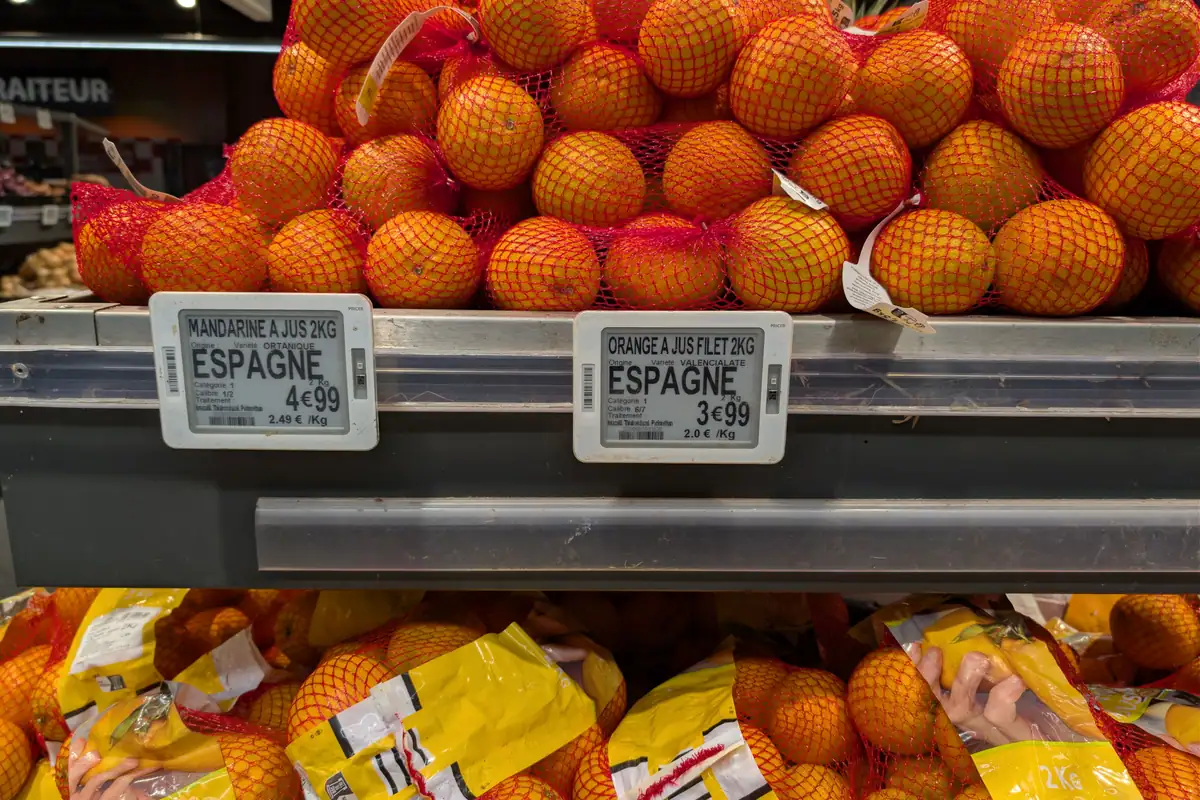

This page is for the independent greengrocer, the farm shop with a produce wall and the produce department of a supermarket. We cover the price pattern, the labelling rules in the UK and the US, and where a screen beats a chalkboard and where it does not.
Three clocks behind a produce price
A greengrocer’s prices do not follow a weekly promotions calendar. They follow three clocks at once:
- The wholesale market. Prices bought at New Covent Garden, a regional market or from a grower change with supply. A good week for English strawberries or a cold snap on Spanish salad shows up on the shelf within days.
- Ripeness. Bananas bought on Monday are worth less on Thursday. Waste is the biggest cost in produce, and the tool to cut it is a timely markdown.
- The week. Saturday afternoon, or the last hour before a long weekend, is when stock that will not last gets cleared.
The result is a pattern unlike a dry-goods aisle: dozens to a few hundred lines, but frequent changes, sometimes more than once a day on the same line, and origin details that rotate with the season.
The UK rulebook for loose produce
The GOV.UK guidance on marketing standards, which applies in England and Wales and was last updated on 17 September 2026, splits fresh produce in two:
| Standard | Products | What loose produce must display |
|---|---|---|
| Specific Marketing Standard (SMS) | Apples, table grapes, kiwi fruit, citrus, peaches and nectarines, pears, strawberries, lettuces, sweet peppers, tomatoes | Country of origin in full, quality class, and variety or type where required |
| General Marketing Standard (GMS) | Most other fresh fruit, vegetables, nuts and herbs | Country of origin; different origins kept separate in the display |
Three details trip up shops:
- No flags, no abbreviations. The origin has to be written in full. A union flag sticker or “ESP” does not count.
- “Local” is not an origin. “Local” or “home-grown” can be added, but not used on their own.
- Mixed origins. Two origins of the same product cannot share one undivided display under one origin ticket.
The Horticultural Marketing Inspectorate checks compliance and may visit. Scotland and Northern Ireland have their own guidance.
This is where an electronic label earns its keep. When Spanish tomatoes give way to British ones in early summer, the price, the origin and sometimes the class change on the same day. Price gets changed because it hurts; origin gets forgotten because it does not. A label fed from goods-in changes them together.
Per kilo, per item, per bunch
The Price Marking Order 2004 requires a unit price for products sold from bulk, so loose produce weighed at the till needs its price per kilo, and the small-shop exemption does not apply to it. Produce sold by number (a pineapple, a lettuce) can be priced per item. The amended Order in force from April 2026 brought new government guidance on when the unit price obligation applies, summarised by Lewis Silkin.
A label template forces a decision for every bay: ”£/kg” or “each”. That is a feature. The bare “£1.99” with no unit, common on chalkboards, disappears.
The US picture: COOL and state unit pricing
In the United States, mandatory country-of-origin labeling still covers fresh and frozen fruits and vegetables; the 2016 change that removed beef and pork did not touch produce (Federal Register). It applies to retailers within the Perishable Agricultural Commodities Act, and a business buying only for retail sale is treated as a dealer once its produce purchases exceed $230,000 in a calendar year (7 U.S.C. 499a). A supermarket produce department is covered; many small farm stands are not.
Unit pricing is a state matter. NIST counts nine states and one territory with mandatory rules and eight states and two territories with voluntary ones. In a mandatory state, a produce label priced per pound or per each must follow the state’s unit rules; elsewhere it is a retailer choice.
Markdowns without breaking reference-price rules
Late-day markdowns are the most quoted reason for electronic labels in produce, and the most misunderstood legally.
- A was/now claim is a reference-price claim. In the UK, savings claims are judged against the pricing practices guidance summarised by Business Companion. In the EU the reference must be the lowest price in the previous 30 days. Our reference price guide walks through both.
- A plain price change is not. Dropping bananas to 49p a kilo at 6pm without a “was” price is simply a new price.
- Schedule the undo. The value of the label is in programming the markdown and reversing it at opening time, so no stale sticker survives into Monday.
Mist, light and colour on the produce wall
Produce walls are wet. Misting systems keep leafy greens fresh, staff wash and re-stack crates, and the wall often sits under the brightest lighting in the shop. Ask for the ingress rating and test labels next to the misting nozzles. Standard e-paper ranges are specified for 0 to 40 °C, which covers ambient produce but not a cold room.
Colour matters more here than in most departments: the screen competes with red peppers and yellow lemons. Red or yellow highlights for offers cost refresh time and battery, as our colour labels guide explains. Viewing distance matters too; customers read a produce wall from above and from a step away.
UK grocers rolling out electronic labels estate-wide include Morrisons, which announced 10.8 million VusionGroup labels across its 497 supermarkets from early 2026 (Morrisons). The release does not break out the produce department, so treat it as context rather than a produce case study.
Chalkboard, printed ticket or screen
| Option | Best at | Weak at |
|---|---|---|
| Chalkboard or hand-written card | Cheap, warm, changed in seconds | Origin and class drift; no price history; handwriting |
| Printed ticket from the till system | Complete and legible | Daily printing; wet paper |
| Electronic label | Price and particulars change together; scheduled markdowns; history | Upfront cost; bays need reassigning; small screen next to a chalkboard |
For a small shop where the owner prices on the spot, a well-kept chalkboard is compliant and cheap. Labels start to make sense with many bays, several staff shifts, more than one shop, or when you need a price history to back up savings claims.
A short plan
- Count display bays and price changes in a normal week and in summer.
- Decide where the price is set: the till system, the scale, or the market buying sheet.
- Trial two or three labels by the misting system and under the brightest lights.
- Put your numbers through the total cost calculator and check the line items in the pricing hub.
If you also run a meat or fish counter, the butchers and fishmongers guide covers catch and origin rules there.
Scope and caveats
Product-specific standards can require more than we list, and enforcement differs between England, Wales, Scotland, Northern Ireland and individual US states. Sources were read on 10 November 2026; this is not legal advice. This site is published by Keonex, as explained on the about page.
Frequently asked questions
What must a loose produce label show in England and Wales?
For the ten produce types under the Specific Marketing Standard (apples, table grapes, kiwi fruit, citrus, peaches and nectarines, pears, strawberries, lettuces, sweet peppers and tomatoes), the country of origin in full, the quality class and, where required, the variety or type. Everything else needs the country of origin. Add the price, per kilo or per item.
Can I just write "local" or "British" with a flag?
No. GOV.UK guidance says the country of origin must be written in full, without abbreviations or flags. Words like "local" or "home-grown" can be added, but never on their own as the origin statement.
Does US country-of-origin labeling apply to loose produce?
Yes, for fresh and frozen fruits and vegetables sold by retailers that fall under the Perishable Agricultural Commodities Act. In practice that means supermarkets and larger produce sellers; a small greengrocer buying less than $230,000 a year of produce is not treated as a PACA dealer.
Is a late-afternoon markdown a "price reduction" with reference price rules?
If you advertise it as a saving against an earlier price, the reference price rules apply. In the UK, that is the pricing practices guidance under consumer protection law; in the EU, the 30-day lowest-price rule. Simply changing the price without a was/now claim is not a reduction claim.
Is a chalkboard still legal?
Yes, if it is clear, legible and next to the produce. Electronic labels do not add a legal requirement; they help when origin and class change as often as the price does.
Sources
- GOV.UK, comply with marketing standards for fresh fruit and vegetables (updated 17 September 2026; accessed 2026-11-10)
- The Price Marking Order 2004, article 5 (legislation.gov.uk; accessed 2026-11-10)
- Lewis Silkin, UK government issues new guidance on the Price Marking Order (24 September 2025; accessed 2026-11-10)
- Federal Register, 2 March 2016, COOL final rule amending 7 CFR part 65 (GPO; accessed 2026-11-10)
- 7 U.S.C. 499a, PACA definitions including the $230,000 purchase threshold (Cornell LII; accessed 2026-11-10)
- NIST, unit pricing laws and regulations by state (accessed 2026-11-10)
- CTSI Business Companion, guidance for traders on pricing practices (accessed 2026-11-10)
- Morrisons partners with VusionGroup to digitise pricing across its supermarket estate (Morrisons, 22 October 2025; accessed 2026-11-10)
- Waveshare e-paper ESL range, operating temperature 0 to 40 °C (CNX Software, 24 January 2025; accessed 2026-11-10)
Work out the total cost of a project
A calculator with editable assumptions: labels, gateways, software, installation and a 60-month rental option. No vendor prices: you supply them.