Electronic shelf labels by sector
Electronic Shelf Labels in Restaurants, Cafés and Food-to-Go
Keonex is a manufacturer and implementer of electronic shelf labels. How we work and why we say so: methodology and transparency.
On this page (9)
- Where a label fits in food service
- UK price display rules for food and drink
- Calories at the point of choice in England
- Allergens on the counter: UK guidance since 2025
- US chains: calories next to food on display
- Fish and shellfish sold by weight
- Independent café or chain
- Working out the cost
- Before you rely on this
In food service the electronic label rarely belongs on the table. It belongs where customers choose standing up and the offer changes daily: the café counter, the grab-and-go fridge, the deli case, the self-service line or the fish sold by weight. There it can carry price, calories and allergens, and swap them when the item does.
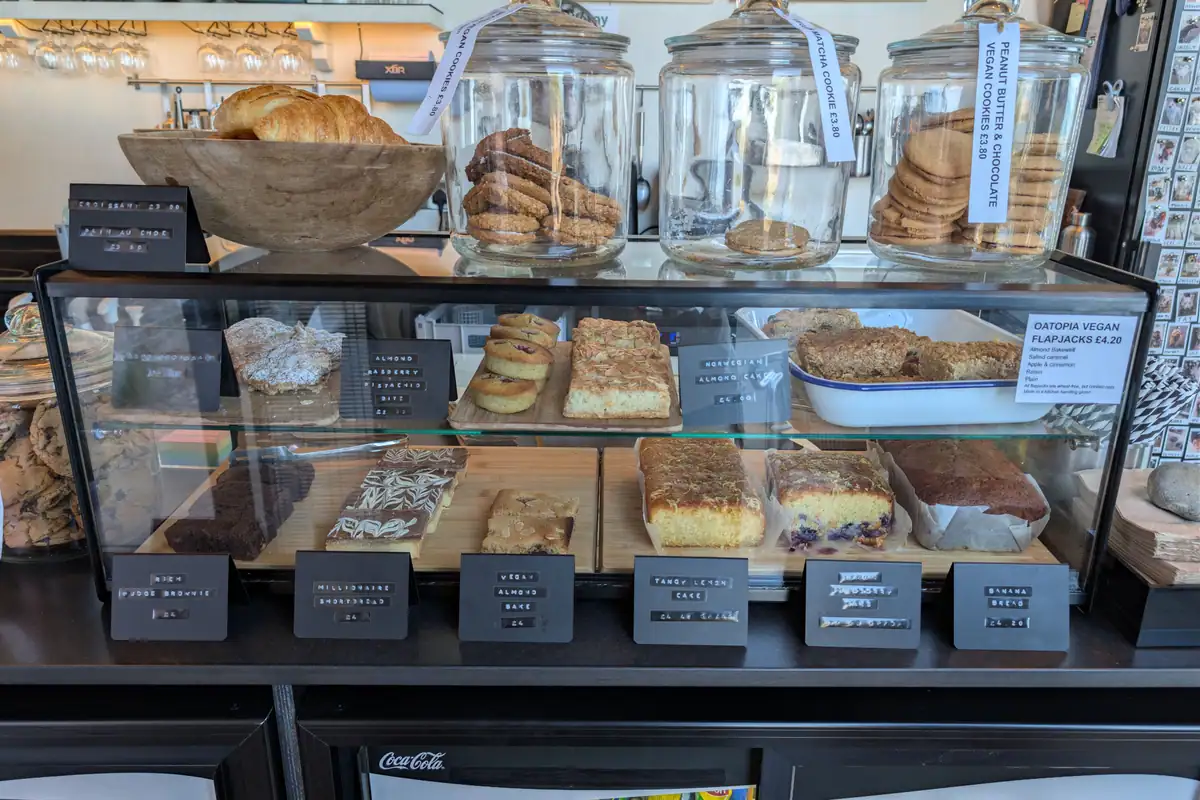

We found no public UK or US case of a restaurant or café chain publishing figures for an electronic shelf label rollout, so this page does not tell case stories. It explains where the technology fits, which UK and US rules shape the label, and what to ask before buying. Hotel buffets, where allergens dominate, have their own guide.
Where a label fits in food service
| Spot | What changes | Electronic label? |
|---|---|---|
| Printed or digital menu at the table | Seasonally | Usually not worth it |
| Specials board at the door | Daily | A screen or chalkboard beats a small label |
| Café counter (pastries, sandwiches) | Product and allergens every morning | Yes, the clearest case |
| Grab-and-go fridge | Range by day-part | Yes, with calorie and allergen fields |
| Deli or salad bar | Dish by service | Yes, like a buffet |
| Fish or shellfish on display, priced by weight | Price per kilo or pound daily | Yes |
| Takeaway counter | Range and price | Yes, with shop logic |
The difference from a supermarket is that a café rarely changes price; it changes what is on show. The label’s job is to keep the information next to each item correct as the items rotate.
UK price display rules for food and drink
Restaurants, cafés and takeaways in the UK follow their own price-marking instrument, the Price Marking (Food and Drink Services) Order 2003. Its main rules:
- What to show. The price of each food item, or the price per weight or quantity where food is sold that way, and any extra charge such as a cover or service charge. Prices must include VAT.
- How many. With 30 items or fewer (excluding wine), all of them; with more, at least 30, including five soft drinks if sold.
- Where. For eating areas, at or near the entrance so customers see it before entering; for takeaway, where the customer chooses the food. Extra or minimum charges must be at least as prominent as the food prices.
- When items run out. The price must be removed as soon as reasonably practicable once an item is no longer available, and, for items sold only at certain times of day, before the next such period.
That last rule is where an electronic label does something paper cannot do reliably. A breakfast range that gives way to lunch at 11:30 can switch on schedule, and a sold-out sandwich can drop off the label when the till says the last one has gone.
Calories at the point of choice in England
Since 6 April 2022, the Calorie Labelling (Out of Home Sector) (England) Regulations 2021 require businesses with 250 or more employees to show the energy content in kcal and the portion size at the point of choice for non-prepacked food sold for immediate consumption. Item labels are one of the listed places, along with menus and websites. Menus not aimed at children must carry the statement “adults need around 2000 kcal a day”. Items on the menu for fewer than 30 consecutive days, and fewer than 30 days a year, are exempt.
For a café chain this turns the counter label into a compliance surface: name, price, kcal, portion and allergens must all be right. When the bakery swaps a recipe, the kcal figure changes with it. Pulling all four from the recipe database is what makes electronic labels interesting here.
Allergens on the counter: UK guidance since 2025
UK law allows allergen information for non-prepacked food to be given verbally, as long as the customer is told where to ask. In early 2025 the Food Standards Agency published best-practice guidance saying written allergen information should always be available for non-prepacked food, alongside a conversation between staff and customers about their needs. It is best-practice guidance, not a new legal duty, and it names restaurants, cafés, delis, market stalls and takeaways as examples (Business Wales).
A counter label with the 14 allergens as icons is one way to meet that expectation. It needs space: icons readable at arm’s length, plus a line for “may contain” warnings that come from your own risk assessment.
US chains: calories next to food on display
In the United States the relevant federal rule is about calories, not allergens. According to the FDA, restaurants and similar retail food establishments in a chain of 20 or more locations, operating under the same name and selling substantially the same menu items, must show calories for standard items on menus and menu boards. For self-service foods and foods on display, calories must appear close to the item and be clearly associated with it. Covered establishments must also say that written nutrition information is available on request and that 2,000 calories a day is used for general nutrition advice. Compliance has been required since 7 May 2018.
A bakery-café chain with a pastry case, or a grocery chain’s hot bar, is exactly the “food on display” case. That nearby calorie declaration can be an electronic label, as long as it is clearly associated with the item and stays correct when the item changes.
Fish and shellfish sold by weight
Seafood restaurants and fish-and-chip shops that display fish for customers to choose often price by weight, and that price changes with the market. An electronic label on the display can show the day’s price per kilo or per pound and change it at lunchtime if a new delivery arrives. If you sell fish to take home rather than to eat, retail rules take over; in the US that includes country-of-origin and wild or farm-raised declarations under 7 CFR 60.300. The butchers and fishmongers guide covers retail fish counters in detail.
Independent café or chain
For an independent café, the fixed cost of a gateway, software and installation weighs heavily against a few dozen labels, and the owner who writes the chalkboard also knows every recipe. For a chain, the maths changes: recipes, calories and allergens come from central specifications, and one change rolls out to every outlet. That is also where grocery has gone at scale: according to Retail Gazette, Co-op planned in 2025 to install electronic labels in at least 40 stores a week across its 2,400-store estate. Governing who can change what across many sites is covered in the retail chains guide.
On the display side, chilled cases and condensation favour e-paper over LCD; the display comparison explains why.
Working out the cost
There are no independent public prices for food-service labels, and we will not invent any. Count counter and case positions, how often the range changes per day, how many outlets you run, and how long staff spend today reprinting tickets for prices, calories and allergens. Then use the total cost calculator and the pricing hub for the line items a quote should include.
Before you rely on this
Scotland, Wales and Northern Ireland have different calorie rules, and US states and cities add their own. Sources were read on 10 November 2026; this is not legal advice. This site is published by Keonex, as explained on the about page.
Frequently asked questions
Do electronic shelf labels make sense in a sit-down restaurant?
Rarely at the table. Menus are read seated and change by season. Labels fit where customers choose standing up and the offer changes daily, such as a café counter, a grab-and-go fridge, a deli case, a self-service line or fish sold by weight.
Which UK businesses must show calories on food labels?
In England, businesses with 250 or more employees selling non-prepacked food for immediate consumption, under the Calorie Labelling (Out of Home Sector) (England) Regulations 2021. Calories and portion size go at the point of choice, which can be the item label. Items on the menu for under 30 consecutive days are exempt.
Do US restaurants have to label calories next to food on display?
If they are part of a chain of 20 or more locations operating under the same name and selling substantially the same items. FDA rules require calories on menus and menu boards, and for self-service foods and foods on display, close to the item and clearly associated with it.
What happens to the price of a dish that has sold out?
In the UK, the Price Marking (Food and Drink Services) Order 2003 says the price indication must be removed as soon as reasonably practicable once the item is no longer available, and before the next period for items sold only at certain times of day. An electronic label can do that on schedule.
Are allergen labels required on a café counter?
In the UK the law lets non-prepacked allergen information be given verbally if signposted, but the Food Standards Agency's 2025 best-practice guidance says written allergen information should always be available. A counter label is one practical way to provide it.
Sources
- The Price Marking (Food and Drink Services) Order 2003 (legislation.gov.uk; accessed 2026-11-10)
- The Calorie Labelling (Out of Home Sector) (England) Regulations 2021 (legislation.gov.uk; accessed 2026-11-10)
- Business Wales, updated industry guidance issued for food allergen information in the out-of-home sector (FSA guidance, 18 March 2025; accessed 2026-11-10)
- Food Standards Agency, allergen information for non-prepacked foods, best practice (GOV.UK, first published 24 February 2025; accessed 2026-11-10)
- FDA, menu labeling requirements (accessed 2026-11-10)
- 7 CFR 60.300, country of origin notification for fish and shellfish (Cornell LII; accessed 2026-11-10)
- Retail Gazette, Co-op to roll out electronic shelf labels to all stores (22 May 2025; accessed 2026-11-10)
Work out the total cost of a project
A calculator with editable assumptions: labels, gateways, software, installation and a 60-month rental option. No vendor prices: you supply them.